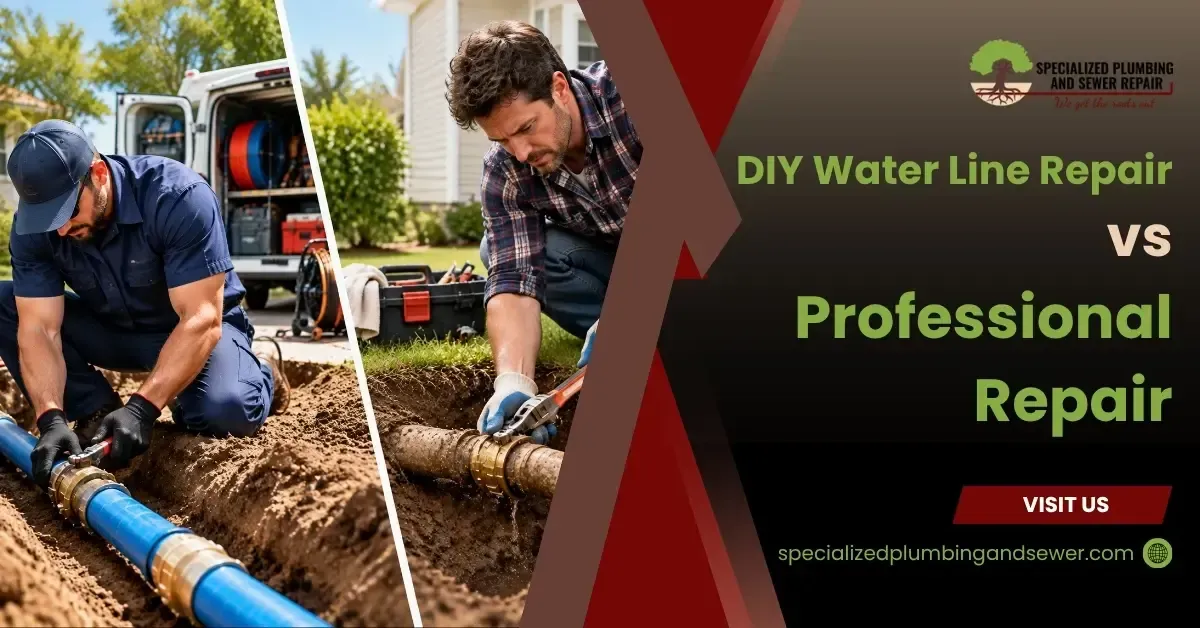
DIY Water Line Repair vs Professional Repair - What You Need to Know
Most DIY water line repair jobs are not safe to do yourself. If the leak sits on the buried supply line between the meter and the house, involves excavation, or requires a permit, the job belongs to a licensed plumber. The only water line work that is reasonably DIY-safe happens above ground: replacing an exterior hose bib, swapping a visible shutoff valve, or fixing a supply line you can shut off and reach without digging. Everything below ground carries permit, contamination, and repeat-failure risks that outweigh whatever the repair would save. Specialized Plumbing and Sewer Repair handles the underground work in the Roseville area so homeowners do not have to guess.
Key Takeaways
Most water line repairs require a licensed plumber, not a DIY fix.
The line between the meter and the house is typically the homeowner's responsibility, and the line from the municipal main to the meter typically belongs to the utility.
Underground water line work almost always requires a permit before excavation begins.
Unpermitted DIY work can void insurance claims for water damage caused later on.
A professional diagnostic inspection (commonly around $165) prevents digging in the wrong spot twice.
Whose Line Is It, Anyway?
The segment of pipe running from the water meter to the house is typically the homeowner's responsibility. The segment from the municipal main to the meter typically belongs to the utility. This split is not universal. Some municipalities draw the boundary differently, so confirm the exact line with your local water department before assuming either way.
A leak on the utility side gets reported to the water department, not repaired in a driveway on a Saturday. A leak on the homeowner side is where the DIY-versus-professional decision actually applies. Homeowners on the fence about scope can also review our water line repair cost breakdown for residential property before making that call.
Skipping this step is also the fastest way to run into permitting trouble. In New York City, for example, all water line repairs within city limits require a permit from the Department of Environmental Protection, and DIY or unlicensed work is illegal and subject to hefty fines. Requirements differ by city, so check with the local building department before starting.
Is This Actually DIY-Safe? A Quick Checklist
A water line repair is only DIY-safe if every item below is true. If any one of these fails, hire a plumber.
The section is on the homeowner's side of the meter, not the utility's side
The repair does not require breaking ground or cutting into a slab
The line can be fully shut off at a nearby valve without affecting the rest of the house
Any replacement fitting is explicitly rated for continuous underground burial and potable water contact, not just above-ground or short-term use
The local jurisdiction does not require a permit or inspection for the specific scope of work
That fourth item trips up more DIYers than any other. Many compression and push-to-connect fittings sold at hardware stores are rated for above-ground or short-term repair use, not for sitting underground under constant soil pressure and temperature swings. A fitting that holds fine on a workbench test can degrade months later once it is buried.
What Actually Goes Wrong With DIY Water Line Repair
The most common DIY mistake is digging where the water is visible instead of where the pipe is actually broken. Water travels along the path of least resistance through loose soil and pipe bedding, so it often surfaces feet away from the real break. A homeowner who digs at the wet spot frequently misses the leak entirely, creates a second hole, and disturbs more of the yard than a targeted repair would have. Our water leak repair services in Roseville locate the actual break first, then dig once.
Professionals avoid this problem with tools most homeowners don't have access to. Video inspection cameras, ultrasonic leak detection, and trenchless repair methods let a plumber confirm the exact break location before any digging starts, the difference between one clean excavation and two messy ones.
The risks compound from there. Underground repair work exposes DIYers to harmful bacteria and contamination risks, and improper patching can leave a pipe more likely to burst again later. None of these outcomes show up on the day of the repair. They show up weeks or months later, often as a bigger problem than the original one.
Permits and Legal Requirements
Underground water line work almost always requires a permit, and skipping it is not a minor paperwork issue. Excavation for water line repair typically requires a permit, and doing the work without one can result in fines and forced rework, regardless of whether the repair itself was done correctly. The same rule applies to related trades, including gas line repair in Roseville, where permits and inspections are required by city code.
In most permitting processes, the inspection has to happen while the trench is still open, before backfill goes in. This step-order requirement is standard in most jurisdictions, but confirm the exact process with your local building department, since some allow alternate inspection paths for smaller repairs. Even well-intentioned DIYers usually get the timing wrong, not the paperwork itself: a homeowner who digs, repairs, and fills the trench back in before scheduling an inspection has made it impossible to pass one without digging the same trench up again.
The Real Cost Comparison (Not Just Labor)
Comparing DIY and professional repair on labor cost alone misses most of the real financial risk. A DIY repair that looks fine on day one can still fail slowly, showing up first as a creeping water bill or a soft, spongy patch of lawn rather than a dramatic burst. By the time that failure is obvious, the original patch usually has to be excavated and removed before the actual fix can happen. That's two dig-outs instead of one.
There's also a financial risk that almost never gets mentioned in DIY guides: insurance exposure.
Insurers can deny claims when the damage traces back to unpermitted work, and in documented California cases have denied coverage for the entire affected area rather than just the unpermitted portion. Coverage rules here vary by state and by insurer, but the exposure is real enough to belong in the decision. A DIY water line repair that later causes water damage elsewhere in the house can end up completely uncovered.
Actual repair costs vary widely by region, pipe depth, material, and access. For deeper cost context, see how water line installation cost for a new home is priced in similar residential jobs. The comparison below is about where the risk sits, not a quote, get a local estimate before deciding.
Approach | Upfront Cost | Real Cost If It Fails |
|---|---|---|
DIY repair | Materials only, the lowest sticker price of the three options | Full excavation cost twice, once to install and once to redo, plus possible water damage, plus a possible denied insurance claim if the failure traces back to unpermitted work (varies by state and insurer) |
Professional spot repair | Labor plus materials; get a local quote, since this varies significantly by region, pipe depth, and access | Workmanship warranty covers a repeat failure, and the work is documented for insurance and resale purposes |
Professional inspection only | Flat diagnostic fee, commonly around $165, though this varies by market | Confirms whether the problem is a spot repair or a sign of a bigger issue before any money is spent on a fix |
What a Professional Repair Actually Looks Like
A professional repair typically starts with diagnosis, not digging. A standalone water main inspection commonly costs around $165 and uses diagnostic equipment to confirm the exact location and severity of the problem before any excavation begins. No guessing, no digging at the wrong spot.
From there, the plumber chooses between a spot repair, a full replacement, or a rerouted line depending on the pipe's age, material, and condition, then handles the permit and inspection process directly. Many now use trenchless methods that minimize yard damage compared to traditional open-trench excavation. This shortens the timeline and reduces the amount of landscaping that has to be restored afterward. Our professional water line repair in Roseville follows this same diagnose-first workflow on every job.
When to DIY and When to Call a Plumber
DIY is reasonable only for above-ground, shut-off-able repairs on the homeowner's side of the meter, using fittings rated for the job. Call a plumber for anything involving excavation, a slab, a permit, or a line whose ownership is unclear.
If the checklist above has even one no, hire a plumber. No exceptions. The upfront quote will almost always look higher than a bag of fittings from the hardware store. Redo risk, insurance exposure, and permit compliance are the reasons that comparison flips once the job goes wrong.
FAQ
Can I Repair My Own Water Line If It's Leaking?
Only if the leak is above ground, on the homeowner's side of the meter, and the section can be fully shut off without digging. Any leak requiring excavation should go to a licensed plumber.
Do I Need a Permit to Repair a Water Line Myself?
In most jurisdictions, yes. Some cities require a permit for any water line repair and treat unlicensed work as a code violation subject to fines. Requirements vary by city, so check with the local building department before starting.
Will My Insurance Cover Water Damage From a DIY Repair Gone Wrong?
Not always. Insurers can deny claims tied to unpermitted work, and documented California cases show denials covering the entire affected area, not just the unpermitted portion. Rules vary by state and insurer, so a repair mistake that seems minor can still end up as an uncovered loss.
How Much Does Professional Water Line Repair Cost?
Costs vary by depth, access, and scope, but a standalone diagnostic inspection commonly runs around $165 before any repair work begins.
How Do I Know if a Water Line Leak Is My Responsibility or the City's?
The line from the meter to the house is typically the homeowner's responsibility, and the line from the municipal main to the meter is typically the utility's, but the exact boundary varies by municipality. The local water department can confirm which section is affected.
Ready to Get It Fixed Right?
Specialized Plumbing and Sewer Repair inspects the line, confirms whether it's a homeowner-side or utility-side issue, and handles the permit and repair process from start to finish, no second dig-out, no guesswork on materials or depth.
We're a family-owned, licensed and insured plumbing company serving Roseville, Rocklin, Granite Bay, Lincoln, Loomis, Citrus Heights, and Folsom, led by master journeyman plumber Charles Hartranft. Free estimates, upfront pricing, no surprises once the trench is open. See our water line repair services or schedule your free estimate to talk through your specific situation. Call (916) 823-1255 for same-day service.
